Whether you've already been diagnosed or you're trying to understand what that bulge or ache really means, you can get clarity here, right in Chicago's western suburbs.
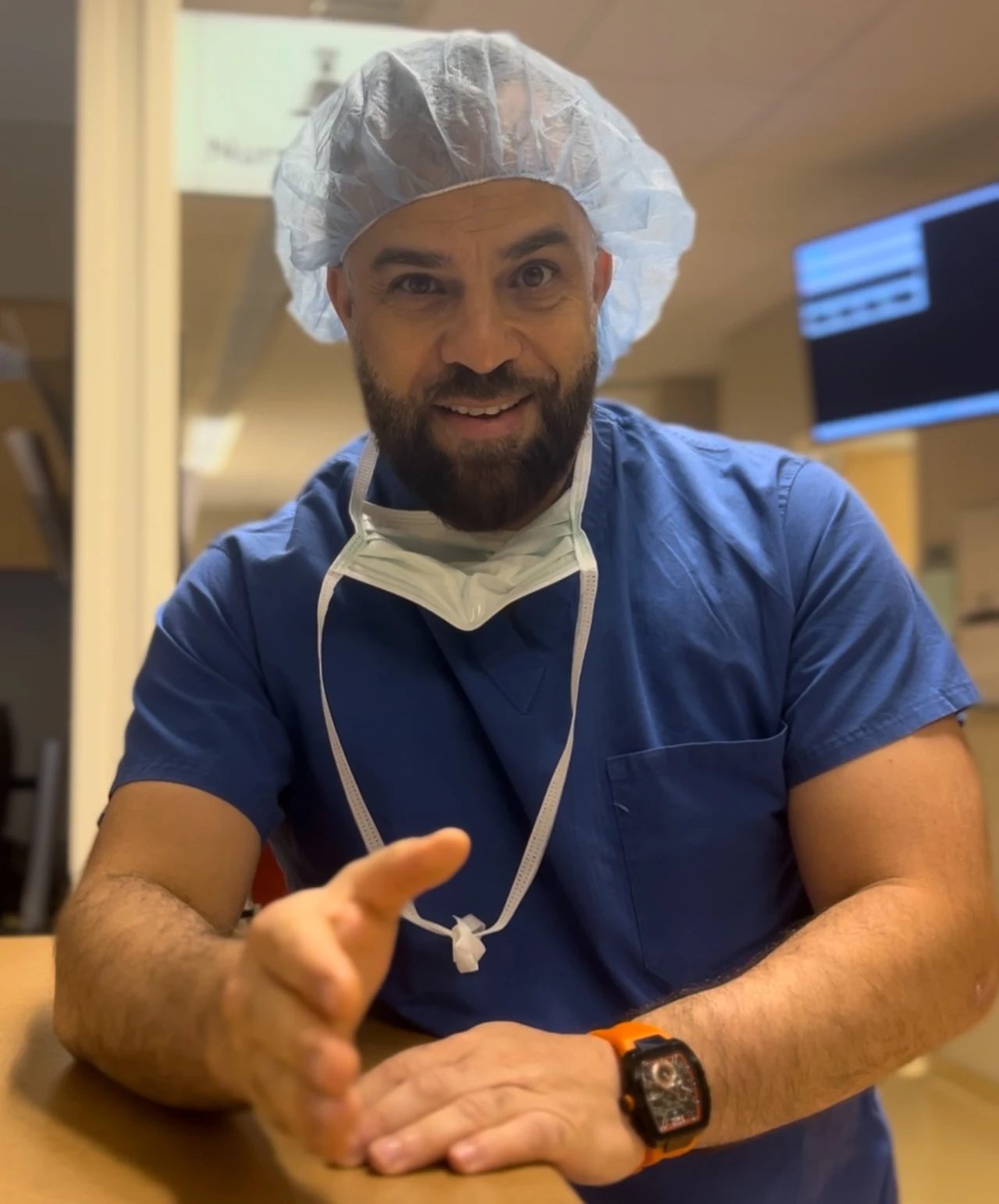
Take our short diagnostic quiz built by Dr. Sofiane El Djouzi, a hernia fellowship-trained surgeon with 15+ years in hernia practice who trained for two years under hernia pioneer Dr. Todd Heniford.
Dr. El Djouzi spent the early part of his career as an academic surgeon in a university research setting, including his last position as surgical faculty at Loyola University Medical Center, before building his own practice in Chicago's western suburbs.
During his fellowship he trained for two years under Dr. Todd Heniford at the CMC in Charlotte, North Carolina, one of the field's true pioneers in minimally invasive hernia surgery, and has continued to refine those advanced techniques across 15+ years and more than 3,200 procedures.
His philosophy is simple: educate first, operate only when it's truly the right call, and follow up with patients for as long as needed. Patients consistently describe an unhurried, thorough approach and a high standard of care.
No pressure, no hard sell. The goal is to help you understand your situation and your choices.
1
Book a consultation
Choose virtual or in-person. A virtual visit often works well. You can show the bulge on camera and Dr. El Djouzi guides you through simple movements.
2
Get a real evaluation
Dr. El Djouzi assesses your specific situation and confirms whether what you have is a hernia, and what type.
3
Understand your options
Watchful waiting, surgical repair, or another path. You'll learn the trade-offs and decide together, fully informed.
4
If you choose repair
An outpatient, mostly robotic procedure at a university-affiliated medical center. Home the same day, back to most activities in about two weeks.
A recovery designed around your life
The fear of being "out of commission" stops many people from getting help. Here's what recovery actually tends to look like after a minimally invasive groin hernia repair.
Day of surgery
Home the same day
An outpatient procedure with no hospital stay. Most patients need prescription pain medication for only a day or two.
Week 1
Up and moving
Walking and stairs are encouraged. Driving resumes once you're off pain medication. Most switch to Tylenol or ibuprofen as needed.
Week 2
Back to your routine
Return to work and light exercise. The simple rule: nothing heavier than 10 pounds for the first two weeks.
After 2 weeks
Full activity, no limits
Gym, heavy lifting, demanding work. Most patients return to everything with no restrictions.
Why patients choose Dr. El Djouzi
Experience and training that go well beyond "we also do hernias."
A Mentored by a pioneer
Two full years of fellowship training under Dr. Todd Heniford, one of the founding figures in modern minimally invasive hernia surgery. Not a brief rotation, but deep, sustained immersion.
B A robotic-first approach
About 95% of repairs are performed robotically, allowing precise, tension-free repair through tiny incisions, which means less pain and a faster return to life.
C Deep mesh expertise
Years spent studying synthetic, biosynthetic, and biologic meshes in the lab and in practice, so the right material is matched to your specific hernia, not a one-size-fits-all choice.
D An educator at heart
A former surgical faculty member at Loyola University Medical Center. The priority is helping you understand your options first, with surgery recommended only when it truly makes sense.
E Care that stays with you
An attentive, unhurried bedside manner before and after surgery, with follow-up that continues for as long as you need it. His team stays reachable across several channels, whether you have a quick question or an urgent concern.
F Command of every technique
A deep understanding of hernia anatomy and reconstruction, and fluency in every approach, open, laparoscopic, and robotic. The method is matched to your specific case, and combined when that gives you the best result.
Groin and inguinal hernia repair in Chicago's western suburbs
Fellowship-trained hernia surgery, close to home. Offices in Darien and Bolingbrook, Illinois.
Inguinal hernia repair
Roughly three out of four hernias are inguinal, the kind that appears in the groin crease. Repair closes the opening and reinforces the weak area so it stays fixed. It's an outpatient procedure, and you go home the same day.
Robotic hernia surgery
About 95% of repairs here are performed robotically, through a few tiny incisions with magnified 3D vision. For most patients that means less pain, smaller scars, and a faster return to work and the gym.
Minimally invasive hernia surgery
Laparoscopic and robotic techniques repair the hernia without one large incision. Dr. El Djouzi is fluent in every approach, open included, and matches the technique to your anatomy and history.
A hernia surgeon near you
If you searched for a hernia surgeon or groin hernia specialist near you, both offices are easy to reach from Naperville, Downers Grove, Woodridge, Lemont, Burr Ridge, and the surrounding suburbs. Virtual consultations are also available.
Already diagnosed and ready to move forward?
If a doctor has already told you that you have a groin hernia, you can skip the quiz and book directly. Virtual and in-person consultations are both available.
"I went into the ER for abdominal pain and Dr. El Djouzi explained I had a hernia and needed repair. Amazing team, great care, great laughs, and he really cares about his patients. He explained what he needed to do and has been there after with follow-up. Very great experience. Very great doctor."
Daisy MoraDecember 2024
★★★★★
"So very happy to have Dr. El Djouzi for my unexpected surgery. He's a very kind man, answering all my questions patiently and thoroughly. My recovery has been exceptionally easy as a result of his care and attention. His team is very helpful and accommodating in arranging follow-up care."
Mary Jo ArmstrongMarch 2024
★★★★★
"I was particularly impressed by the comprehensive approach to patient care. The commitment to safety was evident in every step, from meticulous pre-operative preparation to the use of advanced robotic technology that ensures precision and enhances outcomes. Combining cutting-edge technology with a compassionate, patient-centered approach truly sets them apart."
B. and S.August 2024
★★★★★
"I recovered very well and was able to attend my son's graduation. Thank you so much, everyone."
Trang CongJune 2025
Hernia surgery cost and insurance
Two questions stop most people from picking up the phone. What will this cost me, and does my insurance cover it? Here are straight answers.
Hernia surgery with insurance
Groin hernia repair is a medically necessary procedure, and most commercial plans and Medicare cover it. The office accepts Blue Cross Blue Shield PPO, BCBS HMO Advent, UnitedHealthcare, Cigna, Aetna, Medicare, and most major plans. Before anything is scheduled, the team verifies your benefits and walks you through what your plan covers, so there are no billing surprises.
Inguinal hernia surgery cost without insurance
No insurance, or a plan the office doesn't accept? Self-pay patients get clear, upfront pricing before committing to anything, and because the repair is outpatient with no hospital stay, you'll know the exact number before you decide. Call the office and ask for a self-pay quote.
The 20 questions patients ask most, with clear and straight answers.
About the condition
It's a weak spot or opening in the lower abdominal wall that lets fat or a loop of intestine push through, creating a bulge in the groin. Inguinal hernias account for roughly three out of four of all hernias and are far more common in men.
No. A hernia is a structural opening in the muscle wall, and there are no exercises, medications, or rest that close it. It tends to slowly enlarge over time.
The biggest clue is a bulge. A hernia usually creates a lump that appears with standing, coughing, or straining and shrinks when you lie down. A muscle strain causes pain that improves with rest and typically has no bulge. An exam settles it quickly.
Most are not an emergency and can be planned around your schedule. The risk is if the hernia becomes trapped (incarcerated) or loses blood supply (strangulated), which is an emergency. Repairing it electively avoids that risk.
A natural area of weakness in the groin, combined with pressure over time from lifting, straining, chronic cough, constipation, or aging tissue. Some people are simply predisposed.
Diagnosis & deciding
Usually with a physical exam alone. The surgeon looks and feels for a bulge while you stand and cough. Imaging like ultrasound or CT is only needed in unclear cases.
Often yes. Many groin hernias are visible on camera when you stand and perform a few simple movements the surgeon guides you through. An in-person exam can confirm if needed.
Not always. A small hernia with few or no symptoms can sometimes be watched. But most groin hernias eventually cause symptoms, and studies show the majority of men who wait will need repair within a few years.
It generally enlarges and becomes more uncomfortable, and the small risk of it becoming trapped persists. Repairing it when it's smaller and you're healthy is usually simpler.
Always, if it gives you confidence. Choosing an experienced, hernia-focused surgeon is one of the most important factors in a smooth result.
The procedure
A minimally invasive technique where the surgeon operates through a few tiny incisions using a robotic platform for magnified 3D vision and precise, tension-free repair. It typically means less pain and a quicker recovery than open surgery.
It depends on your anatomy and history. Dr. El Djouzi performs about 95% of repairs robotically, but the right approach is chosen for your specific situation and discussed with you.
Mesh reinforces the weak area and significantly lowers the chance of recurrence. There are many mesh types, including synthetic, biosynthetic, and biologic, and matching the right one to your case is where deep experience matters.
A typical groin hernia repair takes about an hour, though it varies with complexity and whether both sides are repaired.
Robotic and laparoscopic repairs are generally done under general anesthesia. Your team reviews the safest plan for you.
Recovery & results
Yes. Groin hernia repairs are done on an outpatient basis. You go home the same day, usually a few hours after surgery.
Most patients need prescription pain medication for only a day or two, then switch to Tylenol or ibuprofen as needed.
Most people return to work and light activity within about two weeks, following a simple rule of no lifting over 10 pounds for the first two weeks. After that, full activity, including the gym, typically resumes with no restrictions.
Recurrence is uncommon with a well-performed, mesh-reinforced repair by an experienced surgeon. Dr. El Djouzi has not had to reoperate on a hernia repair for early recurrence.
Groin hernia repair is generally covered by most commercial plans and Medicare. The office accepts Blue Cross Blue Shield PPO, Cigna, Aetna, Medicare, and other major plans, and will help verify your coverage.
When to seek care right away
If your bulge turns red, purple, or dark, if you have sudden severe pain, nausea or vomiting, or you can't pass gas, go to the nearest emergency room immediately. These can be signs of a trapped (incarcerated or strangulated) hernia, which is a medical emergency.
Schedule your consultation
Choose a time that works for you, virtual or in-person. Most major plans accepted, including Blue Cross Blue Shield PPO, Cigna, Aetna, and Medicare.